IT & Business Activity Monitoring: The Genesis

Updated: Jun 17

1. The Chaos of the Early Stage
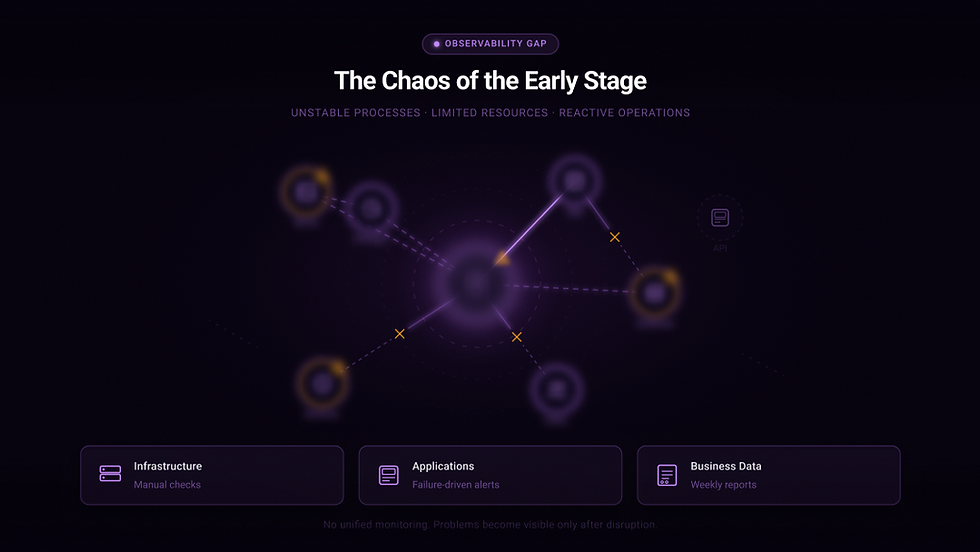
At the initial stages of business development, its structure, processes, and technological foundation evolve in a rather chaotic manner. Budgets are limited while needs are extensive. It is natural for business processes to remain unstable, constantly adapting; IT infrastructure and business automation tools are underdeveloped and cover only the minimum requirements.
The primary goal at this point is to become profitable, reach operational stability, and only then begin planning further development and associated investments.
In such challenging conditions, the most critical factor is the technical team’s ability to build infrastructure, install system software and applications, and provide ongoing support with minimal resources. IT administrators periodically evaluate the condition of individual server and network components. Issues are detected only when an application or service fails. Business activity data is derived from application reports or internal databases, typically once a week.At this stage, IT infrastructure monitoring — let alone business activity monitoring in its modern understanding — simply does not exist.
2. Separate Monitoring

This stage marks the transition of the business into stable growth. There is clarity regarding future plans, market positioning, and marketing strategy, and budgets for development begin to appear. The organization can finally bring order to its operational and technological landscape.
This includes defining organizational structure, employee responsibilities, internal and external business processes, and requirements for business automation tools and IT infrastructure. Typically, the first major IT modernization takes place here: the company adopts branded, scalable hardware solutions, creates infrastructure diagrams and documentation, and establishes standards.IT must now ensure continuous business operations — and monitoring becomes essential, preferably proactive.
Naturally, hardware vendors offer their own monitoring tools. Organizations finally gain the ability to track the health of servers (physical and virtual), operating systems, storage systems, network equipment, performance metrics, utilization levels, availability, and application health.
However, there’s a significant drawback: these are all separate systems, each from a different vendor, none providing a unified view.Moreover, different IT and application components are often assigned to different individuals, divisions, or even departments. When a failure occurs, multiple systems may generate alarms, sometimes in large volumes.
How quickly can the root cause be identified?
Who is responsible for resolving it?
The absence of a unified monitoring platform results in slower incident resolution, higher workload on technical staff, and in many cases, the need for additional personnel.
What about business activity monitoring?
At this stage, companies usually develop internal reporting based on data from business applications and their own databases. This includes financial metrics and various KPIs. Each functional department produces its own management reports—often disconnected and inconsistent. Such analytics remain retrospective, useful mostly for analyzing past performance and adjusting future plans, but not for real-time decision-making.
3. Comprehensive Monitoring

Successful business growth inevitably expands and complicates IT infrastructure. Along with increasing expectations around performance and reliability, this tightens requirements for reaction time and incident resolution.
Separate monitoring tools, for the reasons described above, can no longer deliver the required efficiency.The solution becomes obvious:the company must implement a unified monitoring system for all IT infrastructure components—and ideally, for applications as well—independent of vendor or technology stack.
Fortunately, the market offers a broad range of such solutions. Some focus solely on infrastructure metrics, others incorporate application monitoring, log analysis, transaction tracing, and more. This approach eliminates many limitations of separate tools and provides powerful capabilities.
However, is it perfect? Does it suit everyone?
Simplified tools monitor infrastructure metrics but fail to reveal application behavior.
Advanced solutions are often too complex to implement and configure, suitable mostly for software development companies and high-tech enterprises.
They are expensive and nearly always require project-based deployment and external expertise.
Integration with existing tools is often problematic, while a full replacement is too costly and disruptive.
Most importantly — we still cannot see how IT performance impacts business outcomes.
Meanwhile, business continues searching for clarity using other methods. Static KPI reports are no longer sufficient. Business analytics tools, capable of processing massive volumes of structured and unstructured data, can model strategies and support long-term planning — but are they enough for real-time business management?
In a fast-changing world, decision-makers need to know right here, right now the current values of key business indicators. They must be able to monitor them in real time — something traditional analytics cannot deliver.
4. Business Monitoring

This brings us to the core challenge faced by modern, dynamic, technology-driven organizations in the era of digitalization.
Businesses must have real-time visibility into the state of their key performance indicators, tied to the logic and structure of the organization — all inherently linked to and dependent on IT infrastructure.
This is precisely what business monitoring provides: a tool in which business and IT environments are inseparable.
Within a single system, organizations can simultaneously access monitoring data for:
IT infrastructure
Applications
Business KPIs
…and pinpoint exactly where a performance-impacting issue originates.
These capabilities are embodied in the I&B Monitoring Platform.
Unlike most complex monitoring products, the platform supports fast implementation using internal resources. Its relatively low cost makes it accessible to companies of any size—from small businesses to large enterprises with intricate organizational and technological structures.
It integrates seamlessly with existing monitoring systems and business analytics tools.The business gains full visibility into IT performance and its ability to support business objectives.IT teams gain the ability to demonstrate the need for timely infrastructure upgrades aligned with growing demands to achieve maximum efficiency.
It brings together both business and IT performance indicators within a single application, enabling organizations to understand, correlate, and act on the metrics that truly matter.
You gain a unified business service monitoring system built on IT monitoring best practices, enabling real-time business management and decision-making.
Single Source of Truth.


Comments